This guide converts one patient’s dated record of laparoscopic liver resection into a clear hospital journey: pre-admission, testing, bowel preparation and fasting, surgery, early ward care, mobilisation, diet progression, drain removal, discharge, cost, and planned review. The source refers to the condition as liver cancer but later notes that the lesion might be benign pending pathology. Final diagnosis must come from the pathology report and treating team; this guide does not resolve that uncertainty.
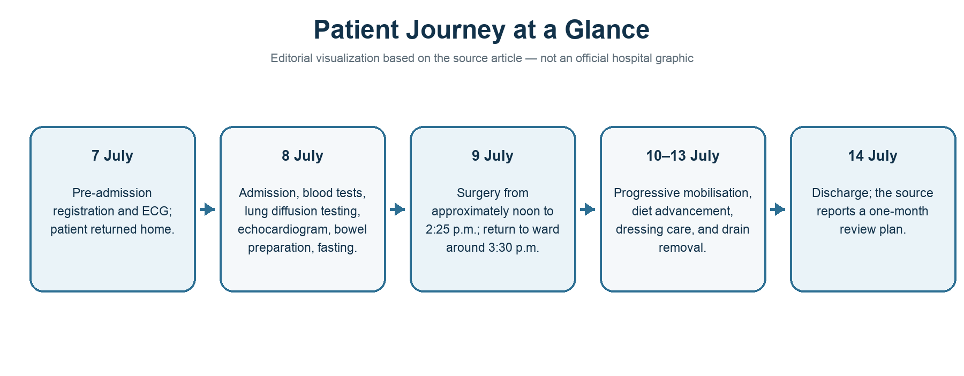
On 7 July, the patient completed pre-admission registration, entered information with the medical team, underwent a 15-lead ECG, and returned home. On 8 July, the source records blood collection, lung diffusion testing, nursing assessments, and echocardiography.
The patient then received bowel preparation instructions, fasting and fluid restrictions, and hygiene instructions including cleaning the navel. These preparations vary by operation and anaesthesia plan. Use only the hospital’s written timing and product instructions.
The source records entry to the operating area at 11:10 a.m., anaesthesia consent at 11:27 a.m., anaesthesia at 11:40 a.m., surgery from about noon to 2:25 p.m., recovery-room observation, and return to the ward around 3:30 p.m.
Family members were taught ward-care measures including repositioning and ankle-pump exercises. The source also reports an allergic reaction during an infusion that was noticed and treated. Any rash, swelling, wheeze, breathing difficulty, dizziness, or sudden change during an infusion requires immediate staff attention.
On the first postoperative morning, rapidly raising the bed to an upright position reportedly caused dizziness, sweating, and abnormal monitored readings. The bed was lowered and the observations returned to normal. This illustrates the need for assisted, gradual position changes after major surgery.
The team encouraged getting out of bed, and the patient later walked for about ten minutes after monitoring equipment and the urinary catheter were removed. Mobility goals must be set by the ward team based on blood pressure, pain, drains, fall risk, and overall condition.
The source describes progression from liquids to semi-liquid foods over several days, dressing changes, intravenous supportive treatment, and drain removal on the third postoperative day. Diet advancement and drain removal depend on the operation and recovery; they should not be copied as a fixed schedule.
A clinician reportedly commented that the lesion might be benign, but the source correctly notes that pathology would determine the diagnosis. Patients should ask when the final pathology will be available, who will explain it, and whether additional treatment or surveillance is recommended.
The patient was discharged on 14 July and reports a planned review one month later. A complete discharge pack should include the operative summary, pathology process, medication list, wound and activity instructions, diet guidance, follow-up date, and urgent contact route.
Seek immediate care for rapidly worsening abdominal pain, heavy bleeding, fainting, breathing difficulty, confusion, persistent vomiting, high fever, jaundice with deterioration, or other symptoms identified by the surgical team.
The source reports RMB 45,437 in total and RMB 10,060 out-of-pocket. These numbers are one admission’s experience, not a quotation. Costs vary with operation extent, pathology, consumables, imaging, insurance settlement, complications, medicines, and length of stay.