This article is adapted from a hospital case story about the cross-border care of a Turkish patient with recurrent nasopharyngeal carcinoma. The case involved Phoenix International Medical Center at The Fifth Affiliated Hospital of Sun Yat-sen University, and it highlights both clinical complexity and international patient support.
For HelixBridge readers, the case is useful because it shows how a serious specialist case may involve far more than one appointment. Prior medical records, treatment history, multidisciplinary evaluation, communication support, family logistics, emergency escalation, cost pressure, and follow-up planning may all become part of the care pathway.

The patient, referred to here by the pseudonym TAN, had been diagnosed seven years earlier in Turkey with non-keratinizing squamous cell nasopharyngeal carcinoma. He initially completed standard chemoradiotherapy locally, and the disease was controlled for a period.
Two years later, however, the disease recurred with cervical lymph node metastasis. Even after lymph node dissection and additional chemotherapy, the disease continued to progress.
According to the case story, TAN later developed tumor invasion affecting important structures, including facial nerves and skull base-related areas. He experienced facial numbness and loss of chewing function, and the disease became increasingly complex and high-risk.
When local treatment options became limited, he traveled to China with his wife and children to seek further care. He first received treatment in Guangzhou and underwent two cycles of chemotherapy at another hospital.
Because the case involved repeated recurrence, resistance after multiple treatment lines, and extensive local invasion, the outside hospital recommended that TAN seek further specialist care from the nasopharyngeal carcinoma team led by Professor Chen Mingyuan. On May 16, TAN was admitted to the special-needs ward of Phoenix International Medical Center.
After admission, the care team reviewed TAN's previous chemoradiotherapy, lymph node surgery, ongoing tumor progression, local necrosis, and overall tolerance for further treatment. A multidisciplinary consultation was initiated to evaluate the case from several clinical angles.
Because the tumor had a wide invasion range and the patient had already undergone repeat radiotherapy and multiple chemotherapy courses, the team first completed vascular imaging to help evaluate bleeding risk. Based on the patient's condition, the team then developed an individualized plan involving immunotherapy combined with chemotherapy.
The first round of treatment was described as standardized, safe, and efficient, and the patient's condition was controlled sufficiently for discharge after that initial admission.
For an international patient with a serious cancer diagnosis, the challenge was not only clinical. TAN and his family also faced language barriers, uncertainty in a foreign country, and the emotional stress of managing a severe illness away from home.
Before admission, the center created a dedicated WeChat communication group to coordinate travel, language support, examination arrangements, and admission details. During hospitalization, doctors and nurses used professional translation software to explain treatment plans, answer questions, and support daily communication needs.
The center also considered the patient's religious and dietary preferences by arranging meals without pork. Because TAN's wife and children accompanied him during hospitalization, the care team also helped comfort the children and reduce the family's burden during the hospital stay.
Soon after discharge, TAN developed severe generalized muscle pain. After communication through the WeChat group, he was readmitted to Phoenix International Medical Center on June 3. The center quickly launched another multidisciplinary review, involving respiratory medicine, rheumatology and immunology, infectious disease, thoracic surgery, and other specialists.
Initial supportive treatment helped control some discomfort. However, three days after admission, TAN's blood oxygen level suddenly dropped. Emergency chest CT suggested atelectasis and worsening lung infection. The team assessed the situation as an immune-related adverse event, complicated by immune-mediated muscle injury and liver injury.
That night, as oxygen levels continued to fall, the team decided to transfer TAN to the ICU for advanced life support. At that critical moment, TAN was worried that his wife and children would be left without support if he moved to the ICU. Professor Chen and the center team reassured him that his family would be properly cared for, allowing him to focus on treatment.
In the ICU, TAN received high-flow oxygen therapy, anti-infective treatment, steroid pulse therapy, gastric protection, anticoagulation, liver protection, myocardial nutrition support, and other comprehensive measures. His indicators gradually improved.
After transfer out of the ICU, he returned to the center for continued recovery. His oxygen level stabilized, generalized pain improved significantly, and he was later discharged.
The case story also notes that ICU costs created pressure for the family. TAN considered leaving the ICU earlier and continuing treatment at the center. The trust built through prior communication and family-centered support appears to have played an important role in the family's decision to continue care within the same medical team.
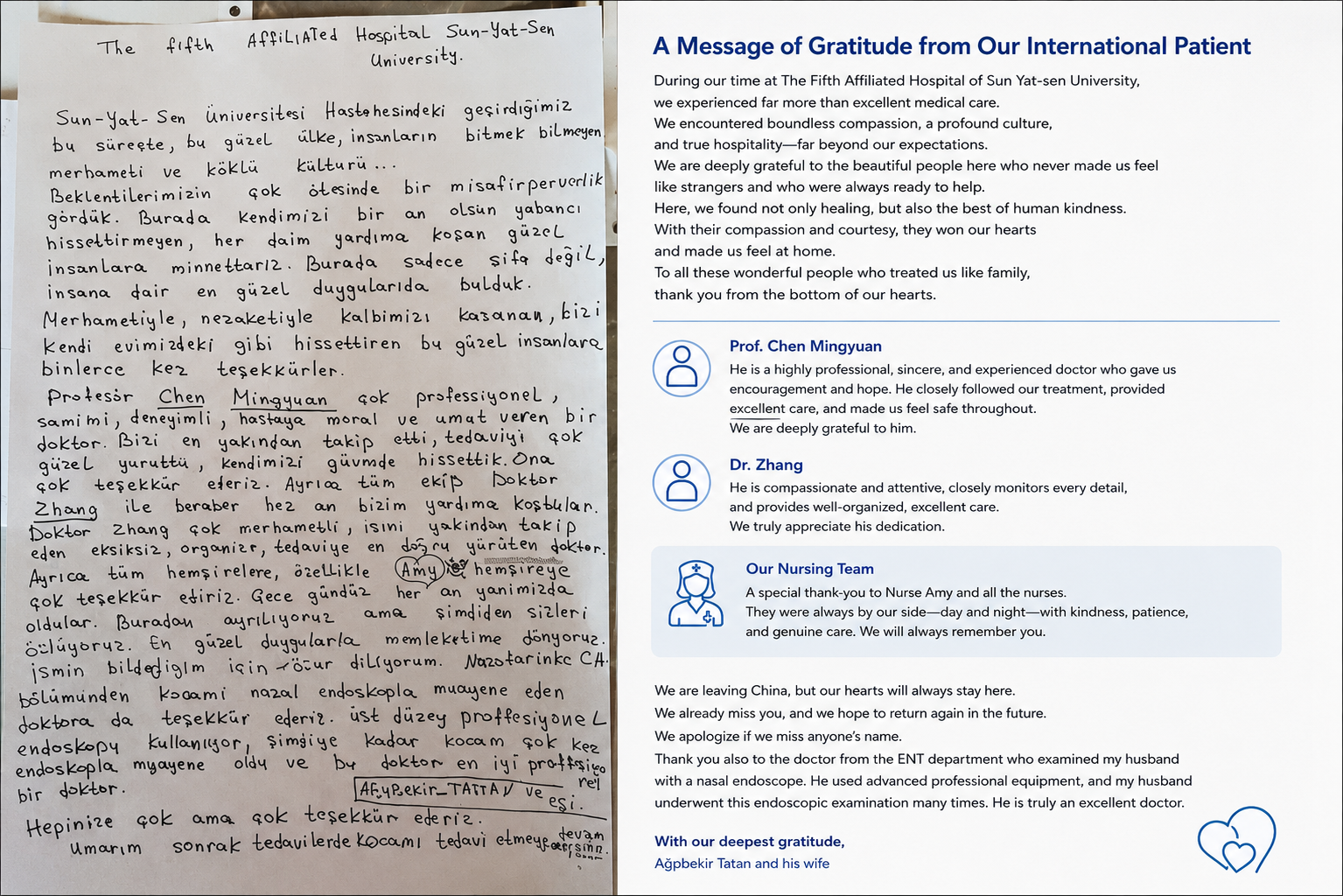
Before discharge, TAN wrote a handwritten thank-you letter to the clinical team. He thanked Professor Chen Mingyuan for professional treatment and continuing support, recognized the team led by Deputy Chief Physician Zhang Fan, and expressed appreciation for the nursing staff and endoscopy team.
For international patients considering complex specialist care in China, this case highlights several practical lessons. First, a serious oncology case requires organized prior records, including pathology, imaging, previous treatment history, surgery records, medication history, and a clear timeline of recurrence and progression.
Second, cross-border care is not only about choosing a hospital. It may involve admission arrangements, language support, dietary or religious considerations, family accommodation, emergency escalation planning, payment preparation, and post-discharge communication.
Third, multidisciplinary review can be especially important for recurrent, treatment-resistant, or high-risk cancer cases. However, whether a patient is suitable for further treatment depends on detailed clinical assessment by qualified doctors. This article should not be interpreted as a recommendation that similar patients should follow the same treatment pathway.
For families traveling across borders, the most valuable preparation may be to build a structured case summary before contacting hospitals: what has been diagnosed, what treatments have been completed, what changed recently, what documents are available, what the patient hopes to achieve, and what practical constraints exist.