This patient experience describes uterine fibroid surgery at Guangdong Provincial People's Hospital in Guangzhou. The patient's mother had multiple uterine fibroids, with the largest measuring 8.1 cm. After reviewing the condition, doctors recommended hysterectomy to reduce future risk and symptoms.
The case is shared for informational reference only. It should not be treated as medical advice, diagnosis, or a guarantee of cost, surgical approach, bed availability, or outcome.
The patient's mother had multiple uterine fibroids. Local doctors previously suggested a combined procedure involving hysteroscopy and colposcopy followed by laparoscopy. The family remained concerned and chose to seek care at Guangdong Provincial People's Hospital.
The family had heard of reputable gynecologists at the hospital and selected Director He Shanyang. After reviewing the test results, the doctor also recommended hysterectomy.
After a pelvic examination, Director He explained that the patient could only undergo open surgery because her vaginal wall was too narrow for hysteroscopy. Robotic and laparoscopic procedures were not considered suitable in this case.
This part of the experience highlights that surgical approach can depend on anatomy, fibroid size, previous surgical scars, uterine condition, symptoms, and the surgeon's assessment. For uterine fibroids, different approaches may include medication, myomectomy, hysterectomy, hysteroscopic procedures, laparoscopic surgery, robotic surgery, or open surgery depending on the case.
The assistant arranged a ward bed. Because the family had traveled from out of town, the doctor made an exception to add an extra bed, and the patient was admitted that afternoon.
After admission, the patient was transferred to the ward once a bed was available, and the surgery time was confirmed. Nurses explained the required procedures clearly. A staff member escorted the patient for examinations after admission. Once the patient met surgical criteria, family members were called to sign consent forms.
The patient had a previous vertical cesarean section scar. At first, because there were numerous fibroids and the uterus was enlarged, the medical team warned that the incision might be longer than the previous scar.
However, the new incision was only about two-thirds the length of the old scar, and the suturing was described as neater. There was no bleeding after surgery, and no blood transfusion was needed despite the patient's mild anemia.
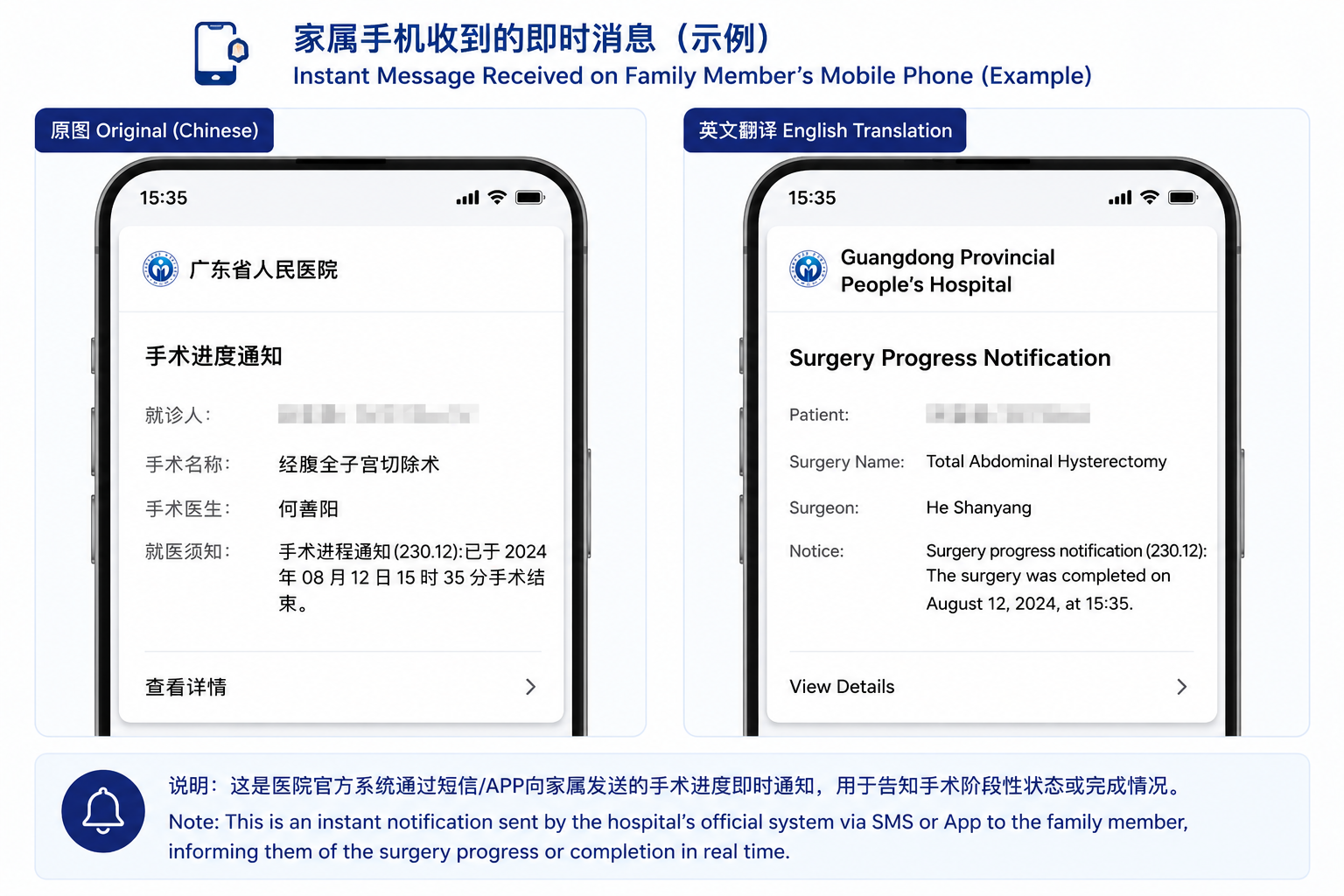
The patient's condition improved day by day after surgery. She was discharged after approximately three to four days.
The pathological report confirmed a benign giant uterine fibroid. According to the family, the patient would no longer suffer from menstrual cramps, anemia, or hypoglycemia related to the previous condition.
The article mentioned an out-of-pocket cost of approximately 600 RMB after medical insurance reimbursement. Actual costs may vary depending on patient condition, insurance eligibility, hospital billing rules, treatment plan, medications, supplies, and length of stay.
For patients considering gynecologic surgery in Mainland China, this case shows the importance of bringing prior imaging, ultrasound reports, blood test results, anemia history, previous surgery records, insurance documents, and a clear list of symptoms. It also shows that the final surgical method may change after in-person examination and specialist assessment.
Patients comparing hospitals should ask about surgical approach, expected hospital stay, transfusion risk, pathology process, postoperative restrictions, follow-up timing, and estimated cost before making a decision.